
SafeRing-Style RMU Accessories: Spare Parts, Replacement & Field Maintenance Guide (2026)
Introduction
As a field medium-voltage maintenance engineer, I have resolved countless ABB SafeRing RMU faults. The ABB SafeRing is a compact, highly reliable sealed SF6 ring main unit widely deployed in utilities, industrial systems, renewable energy stations and commercial power infrastructure.
Most teams mistakenly classify SF6 RMUs as maintenance-free. While the sealed gas tank delivers long lifespan, external and semi-internal accessories inevitably degrade from mechanical cycling, electrical stress and outdoor environmental erosion.
Field data shows 90% of minor SafeRing faults stem from aging accessories rather than body damage. Regular inspection and timely replacement prevent unplanned outages, cut maintenance costs and extend the RMU’s 30+ year service life.
Written for power engineers, EPC contractors and maintenance teams, this guide covers SafeRing accessory functions, fault causes, replacement intervals, part matching rules, original/compatible part comparisons and real field cases, answering top Google maintenance queries.
What Are SafeRing-Style RMU Accessories?
SafeRing-style RMU accessories are modular, replaceable mechanical and electrical components that sustain the switching, monitoring, interlocking and signal feedback functions of medium-voltage sealed ring main units. Unlike the non-wearable sealed equipment enclosure, these parts are consumable maintenance items requiring regular inspection and periodic replacement.
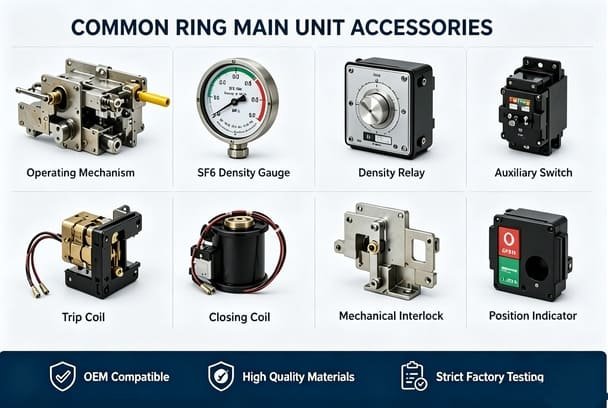
Based on field maintenance experience, all high-wear, high-failure SafeRing accessories are categorized below:
- Core operating components: full set of operating mechanisms, spring charging mechanisms
- SF6 gas monitoring components: density gauges, density relays
- Electrical control components: trip coils, closing coils, auxiliary switches
- Safety interlock components: mechanical interlocks, door locking assemblies, position indicators
- Insulation and wiring components: bushings, cable terminals and sealing accessories
All listed accessories feature a modular design, enabling independent on-site disassembly and replacement. Most replacements require no equipment disassembly or SF6 gas evacuation, significantly lowering on-site maintenance difficulty and costs.
Why Do SafeRing Accessories Need Replacement?
Most accessory failures are progressive, caused by long-term mechanical fatigue, environmental erosion and electrical aging rather than sudden damage. Combined with typical on-site cases, core failure causes fall into four key categories:
1. Mechanical Wear & Fatigue
As the most frequently moving RMU components, operating and spring mechanisms undergo repeated stretching, rotation and joint movement during thousands of load break and earthing switch operations, leading to inevitable mechanical fatigue over time.
Typical on-site case: During routine maintenance of a 12kV SafeRing unit in a Hebei urban distribution network, the team discovered the load switch failed to auto-open after fuse blowing, causing faulty section isolation failure and expanded outages. On-site inspection confirmed spring attenuation and excessive trip line travel in the aging operating mechanism disabled fuse striker triggering. Mechanism accessory replacement and trip line calibration fully restored normal operation.
Common mechanical faults include reduced spring elasticity, bearing jamming, loose joints, stiff manual operation and incomplete switch closure.
2. Harsh Environmental Aging
Outdoor-installed SafeRing units (substations, PV stations, roadside box transformers) endure year-round UV radiation, moisture, dust and corrosion. Rubber seals, plastic parts and uncoated metal accessories age far faster than indoor components.
Typical on-site case: A 6-year-old 24kV outdoor SafeRing unit in a coastal industrial park suffered persistent minor SF6 leakage. Detection ruled out equipment weld seam damage, confirming the fault stemmed from cracked density gauge rubber seals, degraded by long-term salt spray and UV exposure.
Environmental aging commonly causes seal failure, component corrosion and structural deformation, triggering equipment monitoring errors and switching faults.
3. Electrical Fatigue & Contact Oxidation
Trip coils, closing coils and auxiliary switches sustain instantaneous current impact and electrical stress during every protection action and remote switching. Years of repeated operation cause contact oxidation, carbon deposition and coil aging.
Field statistics indicate contact oxidation-induced signal instability and remote tripping faults account for over 30% of SafeRing secondary electrical failures, disrupting SCADA remote monitoring and automatic protection functions.
4. SF6 Monitoring Component Calibration Drift
As precision monitoring parts, density gauges and relays suffer calibration drift from long-term temperature cycling and vibration. Most “false low SF6 density alarms” in field operation result from aging monitoring accessories, not actual gas leakage.
Most Common SafeRing-Style RMU Accessories, Functions & Fault Symptoms
Based on on-site replacement frequency and fault severity, we sorted six core high-frequency accessories, with clear functions, fault symptoms and replacement criteria for quick on-site judgment by maintenance personnel.
1. Operating Mechanism
Core function: Controls opening and closing of load break switches and earthing switches for both manual and electric switching operations.
On-site fault manifestations: Stiff manual operation, incomplete closure, mechanism jamming, unresponsive electric operation and failed linkage tripping.
Replacement suggestion: Replace after 5,000+ switching cycles or when mechanical jamming and spring fatigue occur.
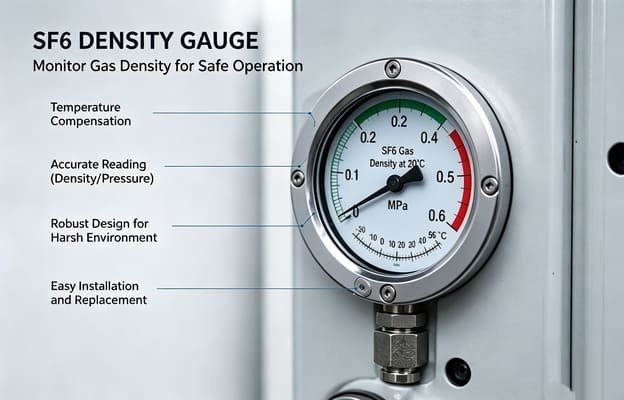
2. SF6 Density Gauge
Core function: Real-time monitoring and display of internal SF6 gas density and pressure with temperature compensation to assess equipment insulation status.
On-site fault manifestations: Unstable pointer readings, inaccurate pressure display, internal oil leakage, broken glass and failed temperature compensation (excessive winter/summer pressure fluctuation).
On-site reminder: Faulty density gauges are the leading cause of unnecessary false alarms and repeated invalid maintenance work.
3. SF6 Density Relay
Core function: Unlike display-only gauges, density relays are protective components that trigger alarms or equipment locking when SF6 density drops below safety thresholds, preventing insulation breakdown risks.
On-site fault manifestations: Frequent false low-density alarms, no response to genuine low pressure, contact failure and severe calibration drift.
4.Auxiliary Switch
Core function: Feeds switch status feedback signals to SCADA, PLC and remote monitoring systems, enabling remote operation and real-time status tracking.
On-site fault manifestations: Lost remote signals, flickering unstable feedback, inconsistent on-site/remote status and poor contact conduction from oxidation.
5. Trip Coil & Closing Coil
Core function : Electromagnetic drive components that execute automatic tripping and closing actions per protection system commands, which are also core wearable parts for all types of distribution switchgears and LV & MV circuit breakers.
On-site fault manifestations : Failed protective tripping, remote closing failure, coil overheating and open/short circuit faults.
6. Mechanical Interlock
Core function: Safety protection components that block hazardous operating sequences (e.g., live closing, grounding switching) to prevent human misoperation and equipment damage.
On-site fault manifestations: Failed interlock protection, abnormal switching sequences, loose/deformed structures and disabled safety locking.
How to Identify Correct SafeRing Spare Parts (On-site Matching Standard)
Mismatched accessories are a top cause of installation failure, mechanism jamming and secondary equipment faults. Many technicians rely solely on visual matching, leading to frequent errors. Summarized from years of parts acceptance experience, five core matching standards ensure accurate part selection:
1. Confirm equipment voltage level: Distinguish 12kV and 24kV SafeRing models, and the internal mechanism size and electrical parameters of different voltage levels are completely incompatible.
2. Check manufacturing year: ABB has updated the accessory structure and process of SafeRing equipment in different batches. Accessories of old and new production years are partially incompatible, and batch matching is required.
3. Verify rated current: 630A and 1250A equipment adopt different specifications of operating mechanisms and conductive accessories, which cannot be used universally.
4. Provide equipment serial number: The device nameplate serial number is the most accurate matching basis, which can query the original factory supporting accessory model and parameter information.
5. Refer to original technical drawings: For equipment with long service life and incomplete parameter information, original installation drawings can completely eliminate matching errors.
Original Factory Parts vs Compatible Accessories
A top concern for engineering purchasers and maintenance managers is choosing between premium original ABB parts and cost-effective compatible alternatives. Below is a practical engineering comparison of their advantages and applicable scenarios based on field operation and cost control needs:
Original ABB Factory Accessories
Core advantages: 100% factory compatibility, official certification, full quality traceability, perfect warranty compliance and zero matching risk.
Disadvantages: High unit cost, long lead times, limited stock for outdated models, unable to support urgent emergency maintenance.
Applicable scenarios: Equipment under warranty, critical substation power assets, projects requiring official certification compliance.
High-Quality OEM-Compatible Accessories
Core advantages: Low overall cost, fast delivery, customizable production, sustainable supply for discontinued models, ideal for large-scale routine maintenance.
Disadvantages: Strict manufacturer screening is required; low-grade generic parts have unstable quality.
Field verification conclusion: Qualified OEM-compatible parts manufactured to original dimensional and electrical standards, and verified via professional testing, match original parts in stability and service life. They are the most cost-effective solution for conventional maintenance projects, especially for project teams adopting Schneider-compatible SM6 style SF6 RMU cabinet for grid renovation.
Scientific Inspection Cycle & Preventive Maintenance Schedule
Preventive maintenance drastically reduces emergency repair costs and downtime. Aligned with power industry standards and field experience, the following practical inspection cycles apply to indoor and outdoor SafeRing core accessories:
| Core Component | Inspection Frequency | Key Inspection Items |
|---|---|---|
| Operating Mechanism | Once every 12 months | Switching flexibility, spring elasticity, bolt tightness, lubrication state |
| SF6 Density Gauge | Once every 12 months | Pointer accuracy, seal integrity, glass damage, temperature compensation effect |
| SF6 Density Relay | Once every 2 years | Calibration accuracy, alarm and locking function test |
| Auxiliary Switch | Once every 2 years | Contact conduction state, signal stability, oxidation and carbon deposition |
| Mechanical Interlock | Full maintenance cycle | Interlock validity, structural integrity, misoperation prevention function |
| Trip/Closing Coil | Functional test every 2 years | Coil resistance, heating state, switching action reliability |
High-Frequency On-Site Fault Questions & Engineer Answers
Below are concise, engineer-verified answers to the most frequently searched SafeRing fault and maintenance questions on Google:
1. Why is ABB SafeRing difficult to operate manually?
Stiff manual operation typically stems from four issues: worn internal mechanism parts, depleted lubrication, spring fatigue or minor structural deformation from vibration. Prioritize lubrication and debugging; replace mechanism accessories if faults persist.
2. Why does the density gauge show low pressure in winter?
SF6 pressure drops naturally with low temperatures. Modern qualified gauges feature automatic temperature compensation to prevent false alarms. Winter low-pressure alerts on aging units usually indicate failed gauge compensation, not actual gas leakage.
3. Can the SF6 density gauge be replaced independently?
Yes. Density gauges adopt a modular independent structure. On-site replacement requires no equipment disassembly or SF6 evacuation, enabling fast, low-cost minor maintenance with minimal outage time.
4. Are compatible SafeRing accessories reliable for long-term operation?
Reputable compatible parts undergo strict dimensional, pressure, electrical and lifecycle aging tests to meet OEM performance standards. Field data confirms high-quality compatible units have operated stably in urban distribution and industrial projects for over 8 years with no batch failures.
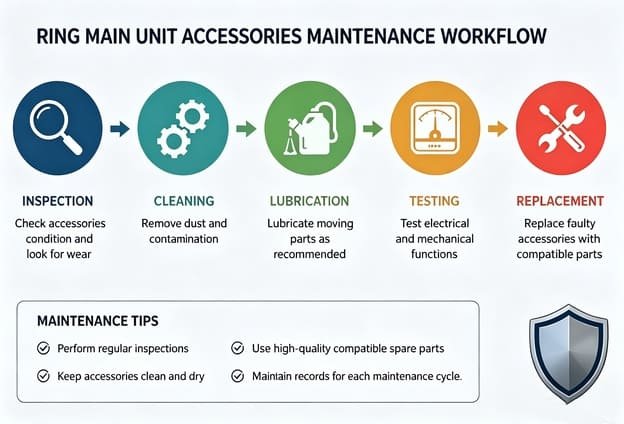
Field Maintenance Tips to Extend Accessory Service Life
These field-proven standardized maintenance practices delay accessory aging, reduce failure rates and extend overall equipment service life:
1. Adhere to regular switching trial operation to avoid long-term static placement of the mechanism leading to spring stiffness and contact oxidation;
2. Keep the equipment cabinet and operating mechanism clean, regularly remove dust and sundries to prevent mechanical jamming;
3. Complete annual corrosion inspection and anti-rust maintenance for outdoor equipment metal accessories;
4.Regularly test auxiliary switch contacts and SF6 monitoring devices to eliminate hidden dangers in advance;
5. Replace aging sealing rubber parts in time to prevent moisture ingress and gas leakage failure ;
6. Store spare accessories in a dry and constant temperature environment to avoid damp aging and deformation.
How to Select a Qualified SafeRing Accessories Supplier
Spare part quality directly determines equipment operational stability. A reliable SafeRing accessory supplier must deliver comprehensive technical support and quality guarantees, rather than just low pricing. Core screening criteria are as follows:
1. Provide complete technical drawings and parameter matching services to ensure 100% installation compatibility;
2. Implement OEM standard production, and provide material certificates and factory test reports;
3. Stable inventory support, to meet emergency maintenance and bulk spare parts procurement needs;
4. Professional engineering after-sales team, providing on-site installation guidance and technical support;
5. Support multi-brand switchgear accessory supply (Schneider RM6/SM6, Siemens RMU, Eaton Xiria, ABB SafePlus) to simplify enterprise spare parts management.
Conclusion
From a front-line maintenance perspective, SafeRing’s long-term stability relies heavily on routine accessory upkeep, not just its sealed body. Most avoidable RMU faults originate from progressive aging of small core components, fixable via standardized preventive maintenance.
For power utilities, EPCs and industrial facility operators, establishing a standardized accessory inspection and replacement system and partnering with professional suppliers minimizes unplanned outages, cuts maintenance costs and maximizes switchgear lifespan. Proactive preventive maintenance remains the most cost-effective equipment asset management strategy.
FAQ
1. What are the most frequently replaced ABB SafeRing accessories?
High-frequency replacement parts include operating mechanisms, SF6 density gauges, density relays, auxiliary switches, trip/closing coils and mechanical interlocks. These components endure the highest mechanical and electrical wear and dominate routine maintenance replacements.
2. Can individual SafeRing accessories be replaced separately?
Yes. Nearly all modular external SafeRing accessories support independent disassembly and replacement. Full RMU replacement and sealed gas tank disruption are unnecessary, ensuring low maintenance costs and fast construction cycles.
3. Are OEM-compatible SafeRing spare parts trustworthy?
High-quality OEM-compatible parts, manufactured to original dimensional and international electrical standards and verified via professional testing, match original parts in stability and service life. They are ideal for routine preventive maintenance and fault replacement scenarios.
4. What is the standard inspection cycle for SafeRing accessories?
Industry standards recommend annual inspection for operating mechanisms and SF6 density gauges; functional testing and calibration of density relays, auxiliary switches and coils every 1–2 years; and synchronous mechanical interlock checks during all maintenance cycles.
5. How to purchase reliable ABB SafeRing accessories?
Select professional suppliers with complete technical documentation, factory test reports, OEM-compliant production capabilities and full after-sales engineering support to avoid secondary equipment faults from inferior mismatched parts.
Disclaimer: ABB and SafeRing are trademarks of ABB. Xizi Energy is an independentmanufacturer of compatible replacement parts. References to ABB SafeRing are forproduct compatibility and identification purposes only and do not imply anyaffiliation, endorsement, or authorization by ABB.
Professional Medium & High Voltage Electrical Equipment Manufacturer