
What Does a Gas-Insulated Switchgear (GIS) Do? A Practical Guide
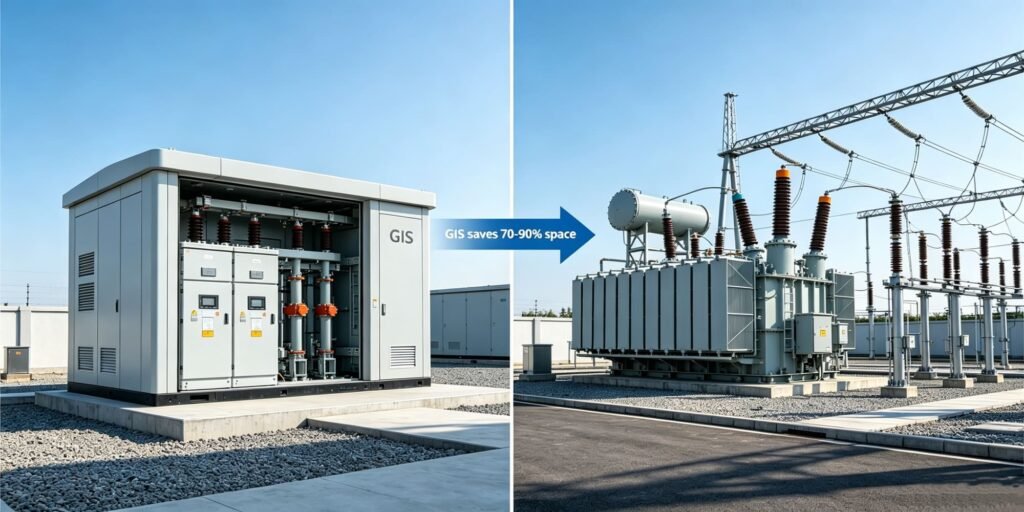
City space is expensive. Power demand keeps growing. The old way—air‑insulated substations—needs a lot of land. That’s why more projects now use gas‑insulated switchgear (GIS) .
A GIS packs all the main gear into a sealed metal box filled with SF6 gas. That includes circuit breakers, disconnectors, earthing switches, current transformers (CTs), voltage transformers (VTs), and busbars.
SF6 has about three times the insulation strength of air. So GIS only needs centimeters to isolate live parts. A traditional substation would need meters. The result? A GIS substation takes up 70–90% less space.
This guide covers what GIS actually does, how it kills arcs, where people use it, and how it stacks up against air‑insulated switchgear (AIS).
1. Four Main Jobs of a GIS
Every GIS does the same four things, no matter the voltage:
- Switching – Turn circuits on or off under normal load.
- Protection – Shut off short circuits fast.
- Measurement – Send current and voltage signals to relays and SCADA.
- Distribution – Take power from incoming lines and send it to several outgoing feeders.
None of these jobs are unique to GIS. What makes GIS different is how it does them. Everything is inside a sealed enclosure. Dust, salt, and humidity don’t get in. Maintenance stays low.
2. How GIS Kills an Arc – The SF6 Arc Quenching Process
When a short circuit happens, the breaker contacts pull apart. An arc forms right away. If nothing stops it, that arc keeps feeding the fault and damages equipment.
Here’s how SF6 stops it.
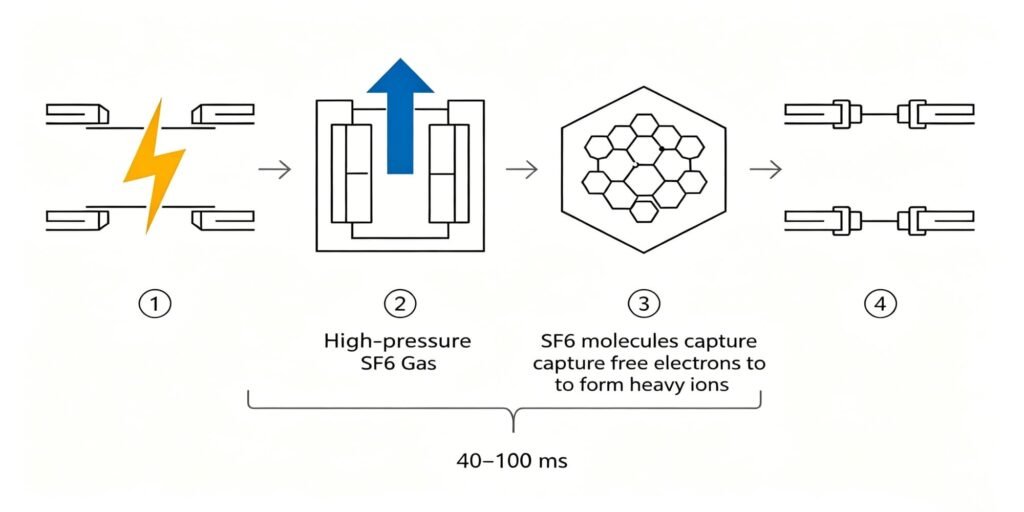
The breaker shoots high‑pressure SF6 into the arcing chamber. SF6 molecules grab free electrons from the arc. Those electrons turn into heavy, slow‑moving ions. The arc loses its path and goes out.
The whole thing takes 40 to 100 milliseconds (2–5 cycles at 50 or 60 Hz). Then the SF6 pressure drops, and the gas goes back into storage. No wear, no replacement.
That’s why SF6 has been the standard for high‑voltage gear since the 1970s. It just works.
3. Key Parts – Breaker Mechanism, CT Polarity, and Gas Leakage
You don’t need to memorize every bolt. But a few parts matter during spec writing, testing, or maintenance.
Breaker operating mechanism – Spring, hydraulic, or hydro‑mechanical. The real risk is pole discrepancy. That means the three phases don’t open at the same time. If they’re off by more than about 4 ms, you can get overvoltages. Good GIS uses sync check contacts to avoid this.
Disconnector and earthing switches – The disconnector gives you a visible break, but it cannot cut load current. The normal earthing switch is for maintenance. The high‑speed earthing switch (HSES) is different. It can close onto a live fault. That’s why codes require HSES at cable ends and transformer connections. Those spots can have induced voltages even after you open the disconnector.
CT polarity – This trips up field crews more than you’d think. If you reverse a CT polarity, directional relays will look the wrong way. Always check polarity during startup. Most GIS comes with multi‑ratio, multi‑core CTs. Protection cores are rated 5P20. Metering cores are 0.2 or 0.5.
Gas compartments and leaks – Each gas compartment has a density monitor. It’s temperature‑compensated. Alarm goes off at about 90% of normal pressure. Lockout at 85%. IEC 62271‑203 allows less than 0.5% leakage per year per compartment. You should do a leak check every year, either with a sniffer or a bag test.
4. GIS vs AIS – Which One Fits Your Job?
Here’s the short version of the differences.
| Feature | GIS | AIS |
|---|---|---|
| Footprint | 10–30% of AIS | Large (tens of square meters) |
| Insulation | SF6 at 4–7 bar | Outside air |
| Pollution trouble | Very low | Moderate |
| Maintenance gap | 10–15 years | 2–5 years |
| Earthquake rating | Up to 9° (0.3g) | Low |
So when do you pick GIS?
Pick it for underground city substations, offshore wind platforms, industrial plants (steel mills, data centers, chemical sites), coastal or desert areas, and anywhere land is expensive or the air is dirty.
Pick AIS for rural projects where land is cheap, the air is clean, and your crew knows open‑air gear. Upfront cost is lower.
Over 30 years, GIS often costs less overall. Land isn’t getting cheaper. And outages cost real money.
5. Where You’ll Actually Find GIS
You see GIS in places where AIS just won’t work.
- Underground city substations – Whole GIS fits in a basement or tunnel.
- Offshore wind – 66 kV to 245 kV GIS saves weight and space.
- Industrial plants – Steel mills and data centers need uptime. GIS gives it.
- Solar farms – Big PV plants use 33–66 kV GIS to connect to the grid.
- Coastal or mountain sites – Sealed boxes handle salt, fog, ice, and animals.
6. Operation and Maintenance – A Realistic Schedule
People say GIS is “low maintenance.” That’s true, but it’s not “no maintenance.” Here’s what a real field schedule looks like.
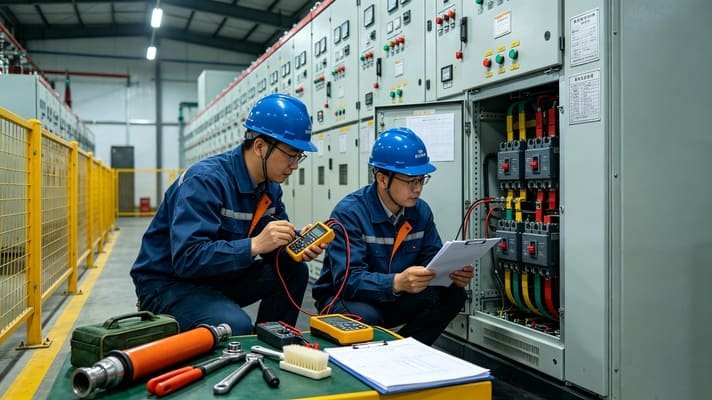
- Daily or weekly – Look at SF6 gauges, check alarm lights, glance at the local control cubicle.
- Every year – Test gas purity (should be 97% or higher), check dew point (below -5°C), hunt for leaks.
- Every 5 years – Do partial discharge testing (ultrasonic or UHF), check contact resistance on disconnectors and earthing switches.
- Every 10 years – Overhaul the operating mechanisms. Replace grease. Check spring charge.
Safety interlocks matter more than most people think. Mechanical key locks stop you from opening a disconnector while the earthing switch is closed. Electrical relays block breaker closing if earthing is on. And here’s a field trick: you can use earthing switches to short CT primaries during primary injection testing.
7. Frequently Asked Questions
What is the main function of a gas‑insulated switchgear?
The main job of a gas‑insulated switchgear is to switch, protect, measure, and distribute power in high‑voltage systems. It packs breakers, disconnectors, earthing switches, CTs, VTs, and busbars into a sealed SF6 box. That lets you build compact substations with very little maintenance.
How does SF6 gas put out an arc in GIS?
SF6 puts out arcs through electronegativity. When an arc starts, the breaker shoots high‑pressure SF6 into the chamber. SF6 molecules grab free electrons from the arc. Those electrons turn into heavy ions that don’t carry current. The arc dies in 40–100 milliseconds. Then the gas pressure drops and the SF6 is ready to use again.
What’s the difference between GIS and AIS?
The main difference is insulation and size. GIS uses SF6 gas, which is three times stronger than air. So GIS only needs centimeters to insulate. AIS uses air and needs meters. That means a GIS substation is 70–90% smaller. GIS also handles pollution better, needs less maintenance, and stands up to earthquakes.
Where do people typically use gas‑insulated switchgear?
People use GIS in tight spaces and harsh places. That includes underground city substations, offshore wind platforms, industrial plants, hydro stations, railway power systems, and polluted areas like coastal zones, deserts, or heavy industrial sites.
If you want to learn the full definition, structure, and basic working principle of GIS equipment, we recommend reading our detailed guide: What is Gas Insulated Switchgear (GIS)?
For comprehensive introduction of SF6 specifications and substitute insulating gases inside GIS, visit: What Type of Gas Is Used in GIS Switchgear?
8. Conclusion
So what does a gas‑insulated switchgear do? It switches, protects, measures, and delivers power. But it does all that in a fraction of the space AIS needs. With less maintenance. And much better resistance to dirt, salt, and shaking.
New gases (g³, Novec 4710) are coming for 145–245 kV gear. But for now, standard SF6 GIS is still the reliable choice for most high‑voltage jobs.
If you’re designing or sourcing GIS equipment for your upcoming substation project, Xizi Energy supplies full-range IEC-certified gas-insulated switchgear and matching GIS spare parts covering 10kV~35kV.
Supported by in-house R&D, factory FAT testing and global after-sales service, our GIS cuts long-term maintenance cost while adapting to coastal, underground and offshore working conditions. Visit Xizi Energy to explore our product portfolio, or contact our engineering team for free customized technical consultation and project quotation.
Professional Medium & High Voltage Electrical Equipment Manufacturer