
SF6 Gas Leakage in Switchgear: Root Causes, Alarm Indications, Field Detection & Preventive Maintenance
For medium-voltage switchgear, ring main units (RMUs) and GIS gas-insulated cabinets, SF6 sulfur hexafluoride remains our primary fill gas. Its high dielectric strength and outstanding arc extinguishing performance make it irreplaceable in distribution power equipment. If the cabinet sealing structure stays intact, SF6-filled gear can run steadily for decades with barely any gas consumption.
Even so, SF6 leakage is one of the most frequent defects we encounter during daily substation maintenance. Slow, continuous gas escape will trigger density relay alarms, weaken internal insulation and drive up recurring service costs. As field maintenance crews, once we fully grasp leakage root causes and stick to standardized inspection workflows, we can greatly boost equipment stability and extend its usable life.
Why We Must Strictly Control SF6 Leakage
The insulation capacity of gas-insulated cabinets hinges entirely on keeping SF6 density within the manufacturer’s rated range. If density drops below the design threshold, the unit loses its safety insulation margin and cannot operate under normal load.
Nearly all modern RMUs and switch panels come factory-fitted with SF6 density relays and gas monitoring sensors to alert staff early when pressure declines. Ignoring these warning signals will slowly degrade insulation and breaking performance, and eventually trigger unplanned power outages for industrial or residential loads.
For utility companies, factory power distribution rooms and new energy stations, timely leak inspection is our most direct way to guarantee safe operation and cut downtime losses.
Root Causes of SF6 Gas Leakage
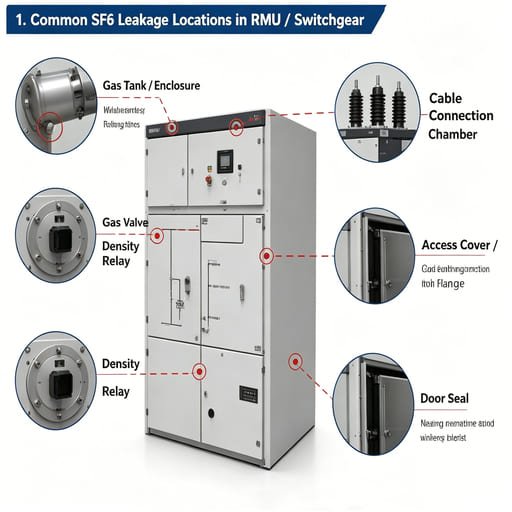
1. Aging, Degraded Seals and O-Rings
Damaged sealing parts are the number one cause of slow SF6 leaks on site.
Rubber gaskets, O-rings and sealing compounds sit through years of temperature swings, humidity and mechanical stress during operation. Over time, these elastic components harden, crack or lose elasticity, forming tiny gaps where gas seeps out.
For any switchgear that has been in service over 10 years, worn sealing hardware accounts for most cases of gradual gas loss we record in maintenance logs. We list compatible seal replacements and overhaul steps for SM6 units inside our Schneider SM6 maintenance troubleshooting resource.
2. Non-Standard Installation or Overhaul Work
Leak points often form due to careless assembly during installation or on-site maintenance, typical issues include:
- Flange bolts tightened with improper torque
- Scratched, uneven sealing mating surfaces
- Misaligned gaskets during reassembly
- Poorly fitted gas valves and auxiliary accessories
Leaks caused by human error rarely show up right after maintenance; they tend to develop slowly over months of repeated thermal cycling.
3. Thermal Fatigue From Temperature Expansion & Contraction
SF6 density shifts directly with surrounding temperature. Outdoor switchgear faces extreme seasonal temperature changes year-round. Constant expansion and contraction create cyclic stress on weld seams, flanges and compartment seals.
All gas-insulated equipment is built to withstand regular temperature variation, but decades of repeated thermal cycles will slowly wear away sealing integrity.
4. Corrosion From Harsh Operating Environments
Units installed near coastlines, chemical plants, mines or high-humidity substations corrode far faster. Corrosion pits form on flange surfaces, valve bodies and cabinet shells, creating permanent paths for gas leakage. We place extra emphasis on monthly visual checks for equipment operating in these corrosive sites.
5. Mechanical Impact and Long-Term Vibration
Knocks during transit, accidental on-site collisions, steady operational vibration or rough handling during installation can deform gas chambers. Even minor structural warping breaks sealing contact and leads to slow SF6 leakage over years of running.
Key Warning Signs of SF6 Leaks We Watch For
Catching leakage early avoids costly full cabinet repairs or unplanned outages. Our field crews prioritize these abnormal indicators during every patrol:
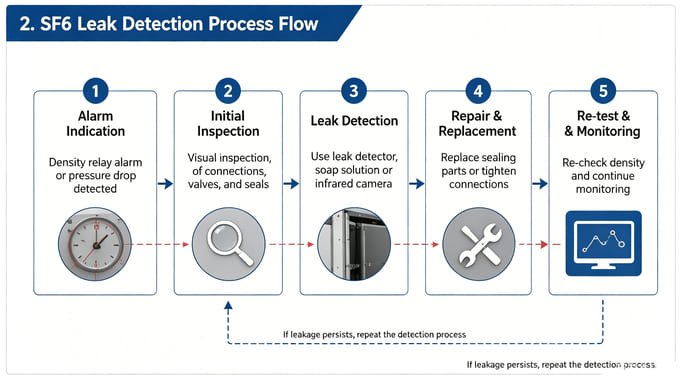
Low-Density Alarms From SF6 Density Relays
A low-density alert is almost always the first obvious sign of gas loss. Install high-precision high-precision SF6 density monitoring device to capture tiny density fluctuations long before alarms trigger.
Unexplained Pressure Gauge Drift
Any pressure fluctuation that cannot be explained by normal ambient temperature shifts means there is an active gas leak somewhere on the unit.
Repeated SF6 Refilling Requests
If a cabinet needs us to top up gas multiple times within a single year, there is definitely an undetected micro-leak we need to locate.
Downward Trends in Digital Monitoring Data
Intelligent online monitoring systems log density values 24/7. By reviewing historical trend curves, we spot slow gas depletion weeks or months before the hardware triggers formal alarms.
Four Practical Field SF6 Leak Detection Methods
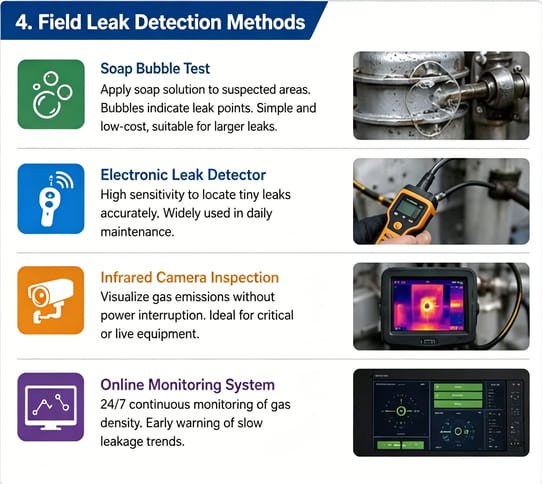
Soap Bubble Test
We coat suspected joints and flanges with diluted soap water; bubbles forming on a surface mark the exact leak spot. This method costs nothing and takes little time to set up, but it only works for relatively large leaks and cannot pick up tiny micro-seepage points.
Handheld Electronic SF6 Leak Detectors
Portable electronic detectors are standard gear for all maintenance crews. They can pick up extremely low leak rates and pinpoint micro-leaks so we only need to disassemble the affected section for repair. After leak repairs, you must complete full relay functional checks — learn how to test an SF6 density relay before re-energizing switchgear.
Infrared Camera Live Inspection
Specialized infrared cameras let us visualize invisible SF6 gas plumes while the equipment remains live. This method eliminates the need for power cuts, making it ideal for critical non-stop distribution feeders.
Permanent Online Gas Density Monitoring
24-hour continuous monitoring systems track density nonstop and catch slow, cumulative gas loss long before alarms activate. We install these permanent systems on all core backbone distribution equipment as a primary preventive measure.
Standard Inspection & Maintenance Intervals
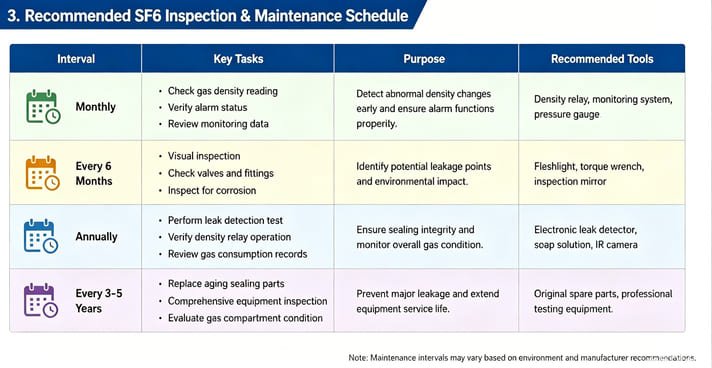
A fixed preventive maintenance plan drastically lowers SF6 leakage risk. The cycle below follows industry common practice; crews can adjust timelines based on local site conditions and the equipment OEM’s operation manual:
Monthly Patrol
- Log SF6 density readings on maintenance records
- Confirm all alarm circuits work as intended
- Archive full monitoring trend data
Semi-Annual Inspection (Every 6 Months)
- Full external visual scan of all gas compartments
- Check gas valves and connecting fittings for looseness or corrosion
- Inspect cabinet shell surfaces for rust or pitting damage
Annual Comprehensive Testing
- Full cabinet leak sweep with electronic detectors
- Calibrate density relays and verify their alarm trigger values via the standardized steps covered in our professional density relay calibration process.
- Tally total annual SF6 refilling consumption for each unit
Major Overhaul (Every 3–5 Years)
- Swap out visibly aged gaskets and O-rings
- Disassemble and fully inspect all gas compartments
- Assess the overall health of the cabinet’s full sealing system
On-Site Case: Slow SF6 Leak on an Outdoor 12kV RMU
During our routine monthly data review, our team spotted a steady downward density trend on an outdoor 12kV RMU supplying a commercial distribution network. At that point, no density alarm had activated yet, but long-term curve data confirmed consistent gas depletion.
We brought out a portable electronic leak detector and traced the leak to an aging O-ring on the load break switch compartment flange. We replaced the seal during the next scheduled power cut; post-repair leak testing confirmed density stabilized with zero further gas loss.
This incident clearly shows the value of tracking monitoring trends and carrying out predictive maintenance. Catching the leak early saved the utility from an unplanned outage and avoided far more extensive compartment disassembly work.
Practical Site Standards to Prevent SF6 Leakage
Grid operators and maintenance teams can cut leak occurrences drastically by following these actionable on-site rules:
- Record SF6 density values monthly and file all trend data properly
- Attend to every density alarm right away with a full cabinet leak sweep
- Only assign certified, trained technicians to work on gas compartments
- Proactively replace aging sealing parts before they start leaking
- Apply anti-corrosion coatings and protective enclosures for equipment in harsh sites
- Build complete maintenance record files for every gas-insulated unit
- Ensure all patrol crews carry calibrated electronic leak detection tools
Preventative maintenance work always costs far less than emergency breakdown repairs or full cabinet replacement jobs.
Need Help with SF6 Monitoring and Switchgear Maintenance?
XIZI Energy supplies:
- SF6 Density Relays
- SF6 Density Gauges
- RMU Spare Parts
- Medium Voltage Switchgear
ComponentsContact our engineering team for technical support, product recommendations, or
eplacement solutions
Conclusion
SF6 switchgear leaks arise from five key sources: degraded seals, improper assembly/maintenance, thermal fatigue, corrosion and mechanical damage. Leaks progress gradually yet steadily erode insulation and grid stability over time.
Early fault identification, regular leak testing and standardized maintenance routines effectively mitigate gas loss and prolong the lifespan of MV switchgear and RMUs. Predictive SF6 monitoring delivers consistent power supply while enabling safer, more efficient distribution operation.
If you need to know the full range of replaceable spare parts for gas insulated RMU switchgear, please refer to our complete ring main unit spare parts introduction guide.
Frequently Asked Field Questions
Is SF6 leakage an immediate safety risk?
Minor slow leaks do not create instant operational hazards. That said, if left unaddressed for a long time, continuous gas loss shrinks insulation safety margins and raises the chance of sudden equipment failure.
How often should we check SF6 density levels?
Most grid teams log density data once a month, with full leak detection testing carried out yearly. All critical backbone distribution equipment runs 24-hour continuous online monitoring.
What counts as an acceptable SF6 leakage rate?
Allowable annual leakage rates differ by equipment model and manufacturer standards. Modern sealed-for-life RMUs and GIS units maintain extremely low annual gas loss that meets factory acceptance criteria.
Can we repair SF6 leaks without replacing the whole switchgear?
Absolutely. The vast majority of leaks stem from replaceable components such as gaskets, O-rings and gas valves, which we can swap out during planned maintenance power cuts.
Why do SF6 density relays send false low-density alarms?
Three common root causes: sharp short-term ambient temperature swings, relay calibration drift, or faulty monitoring sensors. On-site professional calibration testing can separate false alerts from actual gas leakage faults.
Professional Medium & High Voltage Electrical Equipment Manufacturer