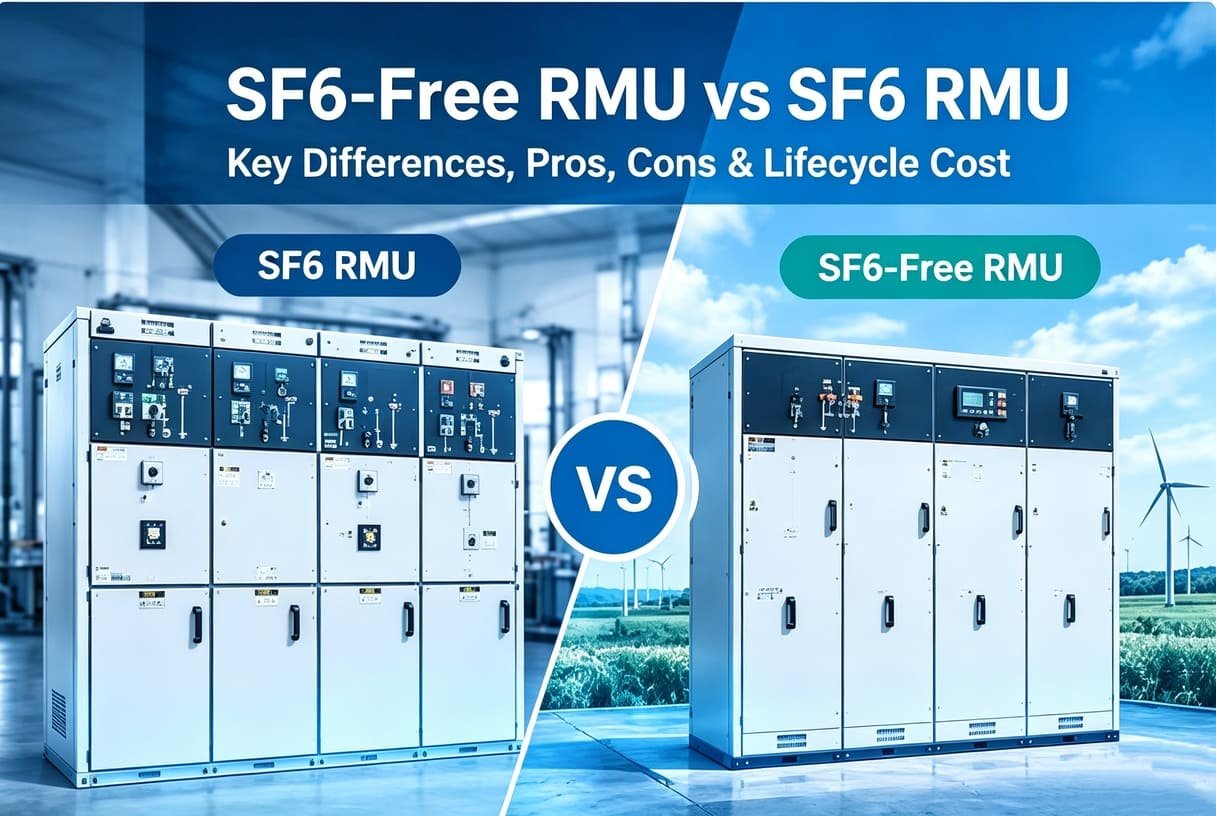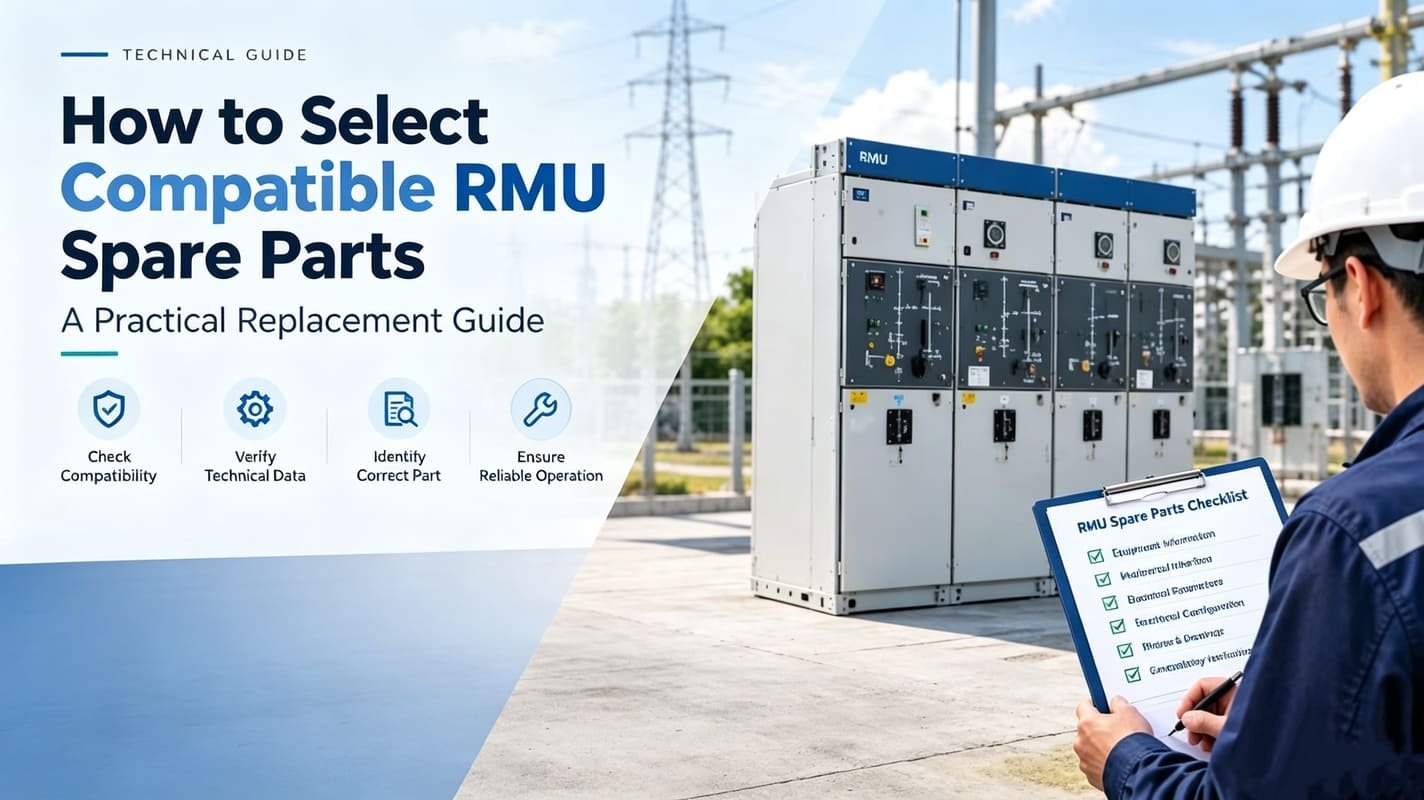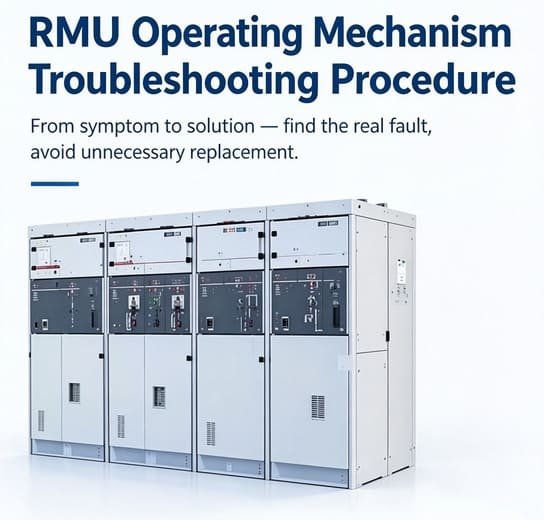

When selecting medium-voltage ring main units for new build or retrofit projects, engineers and procurement teams consistently face one core decision: choosing between an SF6-free RMU and a conventional SF6 RMU.
Technology recency is never the sole deciding factor. The right solution depends on actual project conditions: network voltage, rated current, short-circuit rating, installation space, on-site maintenance routines, local environmental regulations and overall project budget. For equipment replacement projects, physical compatibility with existing substation infrastructure is also a critical deciding factor.
This article fully compares SF6-free RMU vs SF6 RMU from a practical engineering perspective, covering real-world cost differences, maintenance workload, field reliability, retrofit guidelines and 24kV application scenarios.
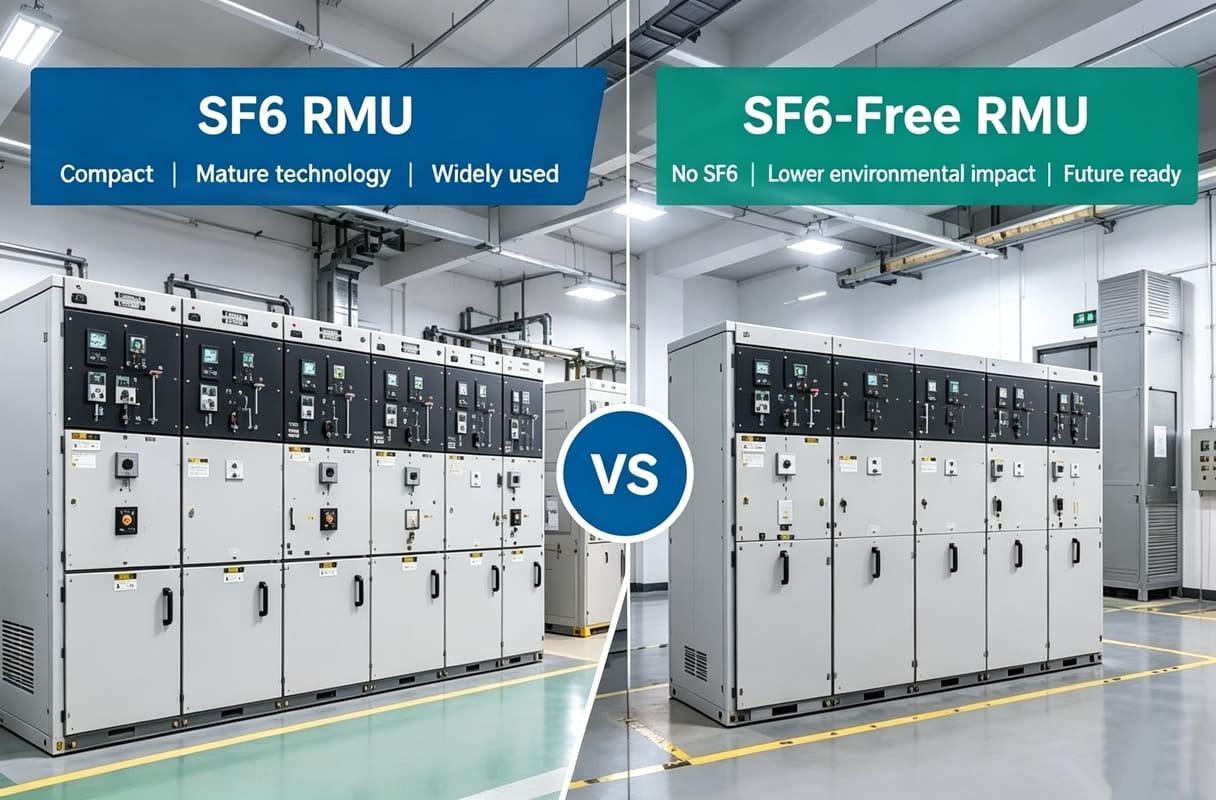
What Is an SF6 RMU?
An SF6 RMU is a compact medium-voltage ring main unit that relies on sulfur hexafluoride (SF6) as its primary insulating medium.
Thanks to SF6’s superior dielectric performance, manufacturers can design highly compact switchgear structures. This is why SF6 RMUs have become the mainstream choice for utility distribution networks, industrial plants, commercial buildings and various types of substations worldwide.
A standard SF6 RMU system integrates load break switches, circuit breakers, earthing switches, cable compartments, busbar systems, and manual or motorized operating mechanisms.
Another major advantage of conventional SF6 RMUs is the massive global installed base. On-site operators are fully familiar with the equipment’s operation logic, and spare parts as well as professional maintenance services are widely accessible in most regions.
The only core drawback lies in SF6 gas itself. As a high-global-warming-potential greenhouse gas, SF6 is now subject to growing regulatory restrictions and environmental supervision across global power industries.
What Is an SF6-Free RMU?
An SF6-free RMU is a medium-voltage ring main unit designed and manufactured without using SF6 insulating gas.
It is important to clarify that “SF6-free” is a general environmental classification, not a unified technical standard. Different manufacturers adopt diverse technical
This technical inconsistency is critical for project procurement. Two products marketed as SF6-free ring main unit options may feature completely different internal structures, external dimensions and operating characteristics.
Instead of simply selecting equipment based on the “SF6-free” label, engineering teams must verify complete technical specifications with focus on these core indicators:
- Rated voltage level
- Rated continuous current
- Required short-circuit withstand level
- Cable connection mode and layout
- Overall physical dimensions
- Motorized or manual operation requirements
- Control voltage configuration
- On-site maintenance and testing procedures
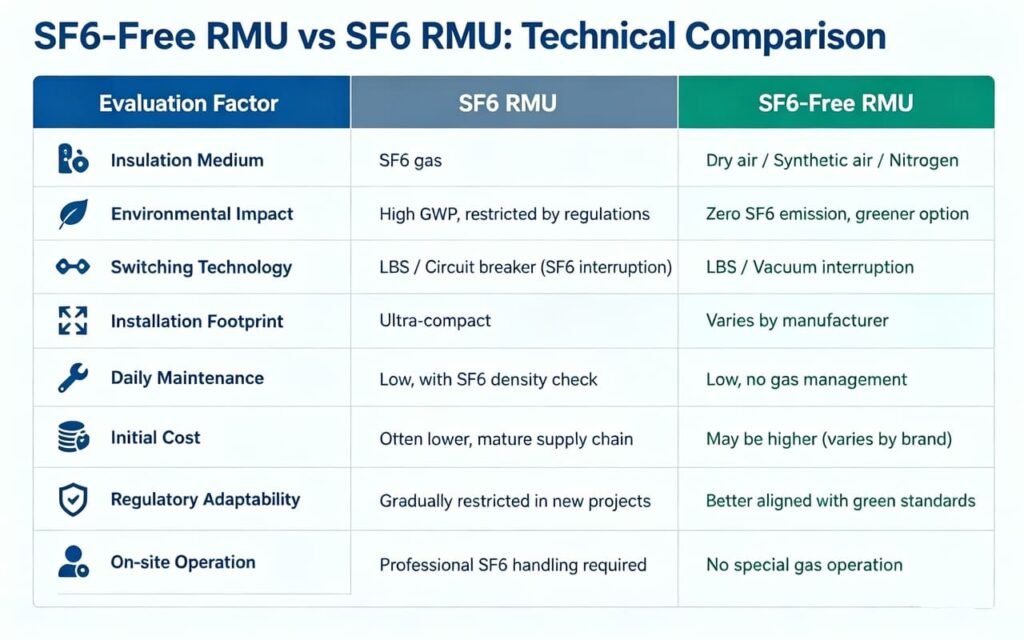
SF6-Free RMU vs SF6 RMU: Practical Core Differences
The following table summarizes the most practical, project-oriented differences between SF6-free RMU and traditional SF6 RMU, covering environment, structure, cost, maintenance and retrofit adaptability.
| Evaluation Item | SF6 RMU | SF6-Free RMU |
|---|---|---|
| Insulation Medium | SF6 gas | Air, dry air, vacuum-based or alternative insulation |
| SF6 Gas Usage | Used | Not used |
| Environmental Profile | High-GWP, environmental concerns | Low-GWP, eco-friendly |
| Equipment Size | Ultra-compact design | Depends on manufacturer’s technical design |
| Maintenance Scope | Standard MV maintenance + SF6 gas management | Standard MV maintenance only, no SF6 handling |
| Initial Purchase Price | Cost-competitive and mature | Higher in certain designs and configurations |
| Installed Base | Large, globally proven | Fast-growing market share |
| Spare Parts Supply | Widely available | Region and brand dependent |
| Retrofit Adaptability | Easy replacement within the same platform | Requires full compatibility verification |
| Regulatory Outlook | Increasing usage restrictions globally | Fully compliant with low-GWP and SF6-phaseout policies |
While the table outlines basic attributes, the actual engineering gap becomes obvious during on-site installation, network connection and long-term operation.
Environmental and Regulatory Considerations
Growing environmental awareness and stricter industry policies are the core drivers for the popularization of SF6-free switchgear.
SF6 gas carries an extremely high global warming potential. The EU F-gas Regulation (EU) 2024/573 represents the global trend of restricting fluorinated greenhouse gas usage in power equipment.
Specific policy requirements vary based on equipment type, voltage level, project application and official implementation dates. Engineers must verify project specifications before confirming whether SF6 equipment is permitted.
Medium-voltage RMUs usually have a service life of 20 years or longer. For new-build projects, forward-looking regulatory risk assessment is essential at the design stage.
Adopting an SF6-free RMU eliminates all SF6-related lifecycle work, including gas leakage monitoring, professional gas recovery and special end-of-life disposal procedures. Even so, SF6-free technology is not universally applicable; overall technical and economic performance must match project demands.
What Changes When Replacing an SF6 RMU?
Most on-site and procurement errors occur during SF6 RMU replacement projects. Although SF6-free RMUs can achieve identical switching and protection functions, they are rarely dimensionally interchangeable with legacy SF6 equipment.
Before conducting any SF6 RMU replacement, fully compare the existing equipment and new unit in the following dimensions:
Rated Voltage & Current Matching
Do not select equipment based only on nominal voltage such as 12kV or 24kV. Verify actual system voltage, continuous current rating, insulation level and load-break/circuit breaker performance to match on-site operating conditions.
Short-circuit resistance is critical for utility and industrial power distribution. Always check short-time withstand current, peak withstand current and short-circuit breaking capacity. Equipment with correct voltage but insufficient short-circuit rating cannot serve as qualified replacement units.
Short-Circuit Capability Verification
Dimensions & Cable Connection Layout
All physical interface parameters must be cross-checked, including overall cabinet size, cable entry position, cable termination height, busbar connection mode, phase arrangement, earthing structure and front/rear operation access space. These details determine whether the new RMU can be installed smoothly in existing substations or compact indoor rooms.
Operating Mechanism & Control Circuit
If the original RMU uses motorized operation, confirm motor voltage and control circuit wiring in advance. For remote monitoring and control, verify compatibility with SCADA, RTU and DTU systems. Unconfirmed control parameter differences will lead to additional on-site modification costs and project delays.
SF6-Free RMU Cost: What Should Be Compared?
Initial equipment price is always the first consideration for procurement teams, but it cannot represent the total project cost.
SF6-free RMU cost is generally higher than conventional SF6 RMUs in many cases. The specific price gap fluctuates with voltage class, equipment configuration, production volume, regional market and project standards.
The correct evaluation standard relies on full lifecycle accounting:
Total lifecycle cost = equipment cost + installation cost + maintenance cost + compliance cost + SF6 gas management cost + end-of-life handling cost
For simple replacement projects with mature SF6 infrastructure, traditional SF6 RMUs still have cost advantages. For long-term new-build projects with strict environmental and compliance requirements, SF6-free solutions deliver better long-term economic benefits.
No fixed price difference standard applies to all projects. Always request unified-specification quotations from suppliers for accurate comparison.
SF6-Free RMU Maintenance
A widespread misunderstanding is that SF6-free switchgear requires no maintenance. In fact, mechanical and electrical components still produce aging and wear during operation, and regular inspection is mandatory.
Routine SF6-free RMU maintenance includes:
- Operating mechanism and mechanical interlock inspection
- Load switch and earthing switch operation testing
- Auxiliary contact and control circuit checking
- Cable termination inspection and torque verification
- Protection relay testing and thermal inspection
The core difference from SF6 RMUs is the removal of all gas-related work. SF6 equipment requires regular gas density monitoring, leakage detection, temperature compensation inspection and professional gas recovery processing at decommissioning. SF6-free designs simplify maintenance workflows while retaining essential mechanical and electrical inspection work.
Reliability: Which Technology Is Better?
There is no absolute reliability gap between SF6-free RMUs and SF6 RMUs.
Traditional SF6 switchgear has decades of stable field operation records. Meanwhile, modern SF6-free RMUs complete strict type testing according to international standards and fully meet medium-voltage distribution operation requirements.
Equipment reliability depends on product design, manufacturing quality and application conditions, not insulation medium alone. When evaluating SF6-free RMUs, verify core technical data: rated parameters, short-circuit performance, insulation level, mechanical endurance, type test reports and environmental adaptability.
Manufacturer after-sales service and spare parts supply capacity are also key factors affecting long-term reliable operation.
Advantages of SF6-Free RMU
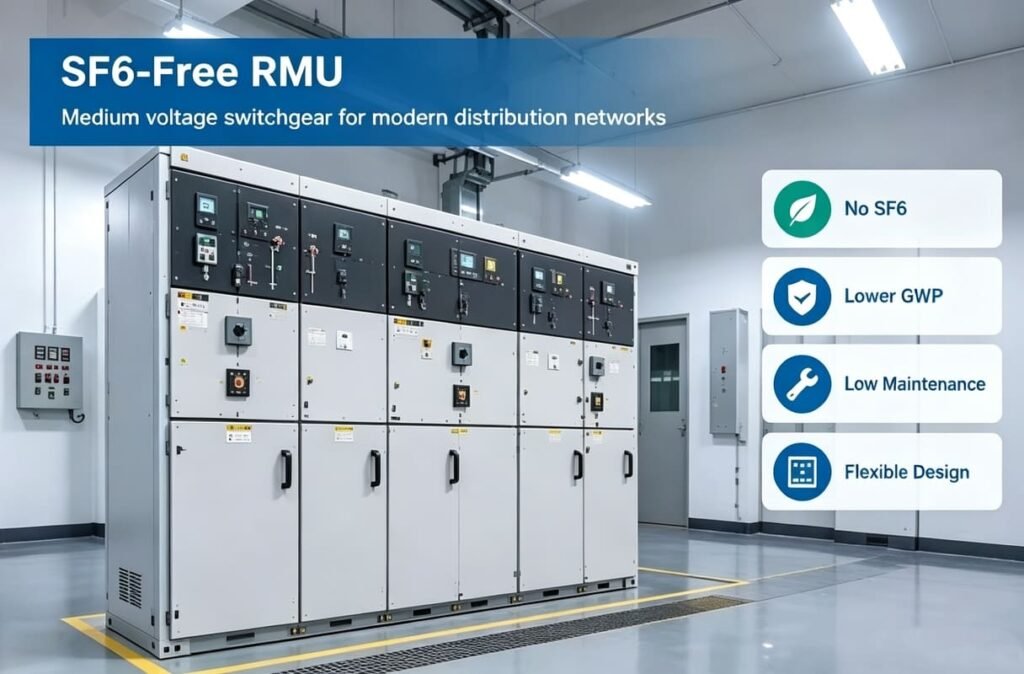
- Low SF6 dependency: Completely abandons high-GWP SF6 gas, matching corporate environmental targets and green power grid construction requirements.
- Simplified asset management: No SF6 monitoring, inflation or recovery work, reducing daily operation and compliance pressure.
- Future-proof performance: Avoids future policy elimination risks during long-term service life.
- Wide new energy adaptability: Ideal for solar power plants, wind farms, battery energy storage systems, data centers, EV charging infrastructure, industrial parks and commercial building distribution projects.
Disadvantages of SF6-Free RMU
- Higher initial investment: Upfront equipment cost is higher than conventional SF6 RMUs in most markets.
- Inconsistent technical standards: Different manufacturers adopt different insulation and switching solutions, requiring detailed technical verification.
- Uneven after-sales resources: Spare parts and local technical service coverage are not as mature as SF6 equipment.
- Strict retrofit requirements: Cannot be used as universal direct replacement for legacy SF6 RMUs.
Is an SF6-Free RMU Suitable for 24kV?
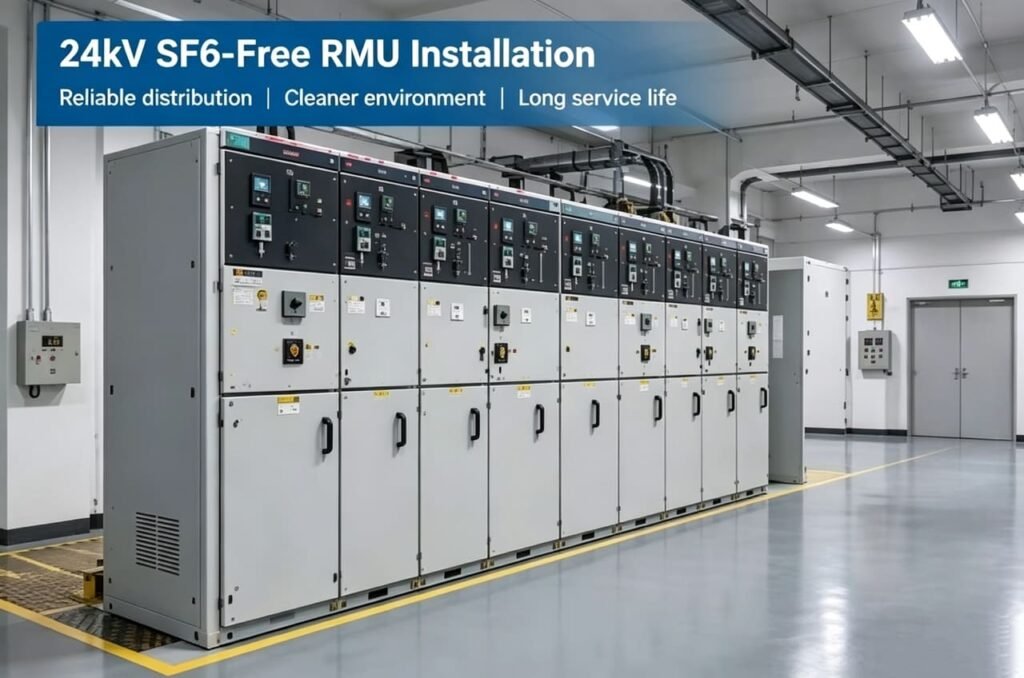
Yes, mature SF6-free RMU 24kV products are commercially available for medium-voltage distribution scenarios.
However, voltage grade alone cannot confirm applicability. For 24kV projects, fully verify these key parameters:
- Rated voltage and continuous current
- Power-frequency and lightning impulse withstand level
- Short-circuit withstand capability
- Load-break and earthing switch performance
- Cable termination layout and protection control matching
This verification is critical for utility and industrial projects with variable on-site short-circuit levels.
Should You Choose SF6-Free RMU or SF6 RMU?
For new-build projects with clear sustainability targets, future policy risk prevention requirements or green project certification demands, SF6-free RMU is the preferred solution.
For projects prioritizing cost control, existing equipment compatibility, mature after-sales service and stable spare parts supply, traditional SF6 RMUs remain a practical and reliable choice.
For retrofit scenarios, equipment compatibility always takes priority. The best solution is not the latest technology, but the one that fully matches electrical parameters, installation conditions, on-site maintenance capabilities and long-term operational economy.
If you are evaluating SF6 RMU replacement or selecting SF6-free RMU equipment, provide your equipment rated parameters, configuration requirements and original nameplate/drawing information.
We can complete professional technical compatibility verification and project quotation customization for your medium-voltage switchgear project.