
For switchgear operators, the core principle is clear: SF6 pressure drops with falling ambient temperature, even when the gas volume inside sealed compartments remains unchanged.
A typical 24kV RMU may show stable pressure readings in summer but display lower pressure in cold winter weather. This low reading cannot confirm actual SF6 leakage. This is the critical drawback of pressure-only monitoring: it tracks pressure values but cannot reflect the true operational state of SF6 gas. You can check our full tutorial about troubleshooting and replacing faulty RM6 density gauges when false alarms appear on site.
What Changed After Density Relays Were Adopted
SF6 density relays are designed specifically to resolve the flaws of traditional pressure monitoring.
Instead of relying on raw pressure data, they integrate real-time temperature compensation and convert field readings into standardized density values under reference conditions. This delivers accurate, reliable assessment of actual SF6 gas status inside switchgear.
For on-site operators, the advantage is intuitive: alarms only trigger when gas density drops to critical levels, rather than responding to normal temperature fluctuations. This optimizes maintenance judgment and eliminates unnecessary on-site inspections.
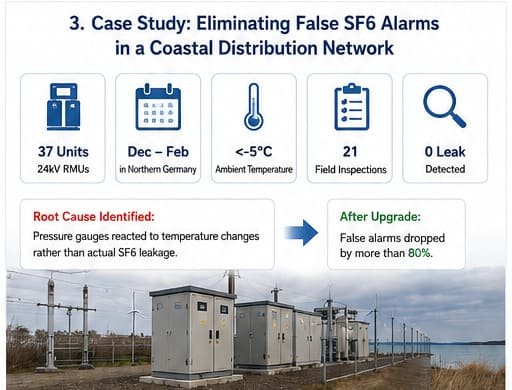
Case Study: Eliminating False SF6 Alarms in a Coastal Distribution Network
A utility operating 37 units of 24kV RMUs
in Northern Germany reported repeated low-gas alarms during winter.
The alarms occurred mainly between December and February,
when ambient temperatures regularly dropped below -5°C.
Over a six-month period,
maintenance crews performed 21 field inspections.
Leak testing confirmed that none of the gas compartments had actually lost SF6.
Engineers eventually identified the root cause:
pressure gauges were reacting to temperature changes rather than gas leakage.
After replacing the monitoring devices with temperature-compensated density relays,
false alarms dropped by more than 80%.
Why Modern GIS and Circuit Breakers Adopt Density Relays
Modern switchgear features compact structural design and strict reliability standards, creating higher demands for precise SF6 gas monitoring. Density relays deliver dual-layer safety protection that pressure gauges cannot match.
Alarm Function
When gas density falls below the warning threshold, the relay outputs an alarm signal to the control system. This enables early inspection and troubleshooting before equipment performance degrades.
Lockout Function
If density continues dropping to the minimum safe limit, the relay activates a lockout contact. This prohibits switchgear operation under dangerous low-density conditions and prevents equipment damage.
In short: pressure gauges only reflect parameter changes, while density relays deliver active equipment safety protection.
Pressure Gauge vs Density Relay: Modern Application Analysis
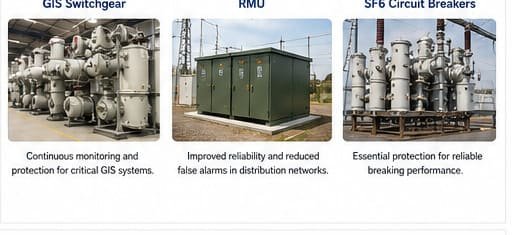
Both devices have applicable scenarios. Pressure gauges are cost-effective for basic on-site visual pressure indication. However, for core equipment including GIS, RMUs and high-voltage circuit breakers that prioritize safety and stability, density relays offer irreplaceable advantages.
| Feature | Pressure Gauge | SF6 Density Relay |
|---|---|---|
| Pressure Indication | Yes | Yes |
| Temperature Compensation | No | Yes |
| Accurate Leakage Assessment | Limited | Yes |
| Alarm Contacts | No | Yes |
| Lockout Protection | No | Yes |
| Remote Monitoring Capability | Limited | Yes |
| Suitable for Critical GIS/RMU Applications | Limited | Yes |
Currently, pressure gauges are mostly used as auxiliary display devices, while density relays serve as the core monitoring and protection solution for modern switchgear.
SF6 Density Relay Selection Guide for GIS and RMU
Density relays vary in performance and adaptability. Engineers need to evaluate key parameters to match actual project and operating conditions.
Alarm and Lockout Contacts
Independent alarm and lockout contacts are standard for most utility projects. They support early fault alerts and graded safety protection to avoid sudden equipment operation restrictions.
Temperature Compensation Range
A wide, stable temperature compensation range is essential for regions with drastic seasonal temperature changes, effectively suppressing false alarms and improving monitoring accuracy.
Environmental Protection Rating
Outdoor and harsh-environment installations require IP65 or higher protection to resist dust, moisture and weather erosion.
Communication Capability
To adapt to digital substation construction, modern relays support RS485 and Modbus protocols for seamless SCADA integration and remote online monitoring.
Industry Standard Compliance
Products compliant with IEC 62271 and other mainstream switchgear standards are universally recognized by utilities and EPC contractors for better compatibility and reliability.
Industry Trend: From Passive Monitoring to Intelligent Asset Management
SF6 monitoring is evolving from simple status detection to intelligent asset management. More utilities are connecting density relays with SCADA and asset management platforms.
The system can track long-term density variation trends, identify subtle leakage risks in advance, and support predictive maintenance. This shifts the operation mode from passive fault handling to proactive asset management, which will become a core feature of future digital substations.
Engineering and purchasing teams should run through these checks ahead of buying to steer clear of fit issues and high long-term upkeep costs:
- Is this relay built for GIS, RMU or circuit breaker use?
- What temperature span does its compensation cover?
- How many separate alarm and lockout contacts come fitted?
- Does it work with RS485 or Modbus communication?
- Will a formal calibration certificate be supplied with each unit?
- What IP protection grade does the housing have?
- Is local spare stock and on-hand technical assistance accessible?
- What realistic working lifespan can we expect from the unit?
Frequently Asked Questions
Can SF6 pressure gauges accurately detect leakage?
No. Pressure readings fluctuate with both gas loss and ambient temperature changes. A low pressure value cannot confirm actual leakage.
Why do density relays adopt temperature compensation?
SF6 pressure is temperature-dependent. Compensation eliminates environmental interference, accurately judges real density changes, and avoids false alarms.
Are density relays mandatory for GIS?
Requirements vary by project specification, but modern GIS widely adopt density relays for their integrated monitoring, alarm and protection functions.
Can density relays connect to SCADA?
Yes. Most modern relays support RS485/Modbus communication for remote monitoring and system integration.
What is the test cycle for density relays?
Testing follows manufacturer guidelines and utility maintenance rules, usually conducted during routine switchgear overhaul.
What separates a density relay from a density monitor?
Density relays come with switching contacts to trigger alarms and equipment lockouts for active protection. Basic density monitors usually only display readings without any output control functions.
What communication protocols do modern relays use?
RS485 and Modbus RTU are standard; these let you link the relays straight into SCADA and equipment asset management platforms.
Can density relays be recalibrated later?
Absolutely. Most models get recalibrated during routine switchgear servicing to stay accurate and match utility compliance rules. Follow our full step-by-step workflow in our dedicated SF6 density gauge calibration guide.
What triggers false low-gas alerts most often?
Temperature swings are the top culprit. Cold weather drags pressure gauge readings down even when no SF6 has leaked out of the sealed tank.
How long do density relays normally last?
Lifespan varies based on location, humidity and maintenance habits. Most units run reliably for over a decade inside standard switchgear cabinets.
Conclusion
Pressure gauges deliver only basic SF6 pressure readings and fail to accurately assess true gas conditions, as they cannot rule out temperature-induced pressure fluctuations.
SF6 density relays resolve this critical limitation via precise temperature compensation, early fault alarms and equipment lockout protection. They enable accurate leakage judgment, smarter maintenance decisions and safer switchgear operation.
For modern GIS, RMUs and SF6 circuit breakers, density relays are no longer optional extras — they are essential components that underpin equipment reliability and stable power system operation.
Professional Medium & High Voltage Electrical Equipment Manufacturer