
In the power system, high-voltage circuit breakers are critical components for ensuring grid safety and stability, and their operating mechanism serves as the “core drive” that enables reliable switching operations.
As a key part of medium and high-voltage electrical equipment, the operating mechanism’s performance directly determines the circuit breaker’s ability to interrupt fault currents, isolate faulty sections, and restore normal power supply—making it indispensable for industrial power grids, renewable energy plants, and commercial electrical systems.
Core Principles of the Operating Mechanism
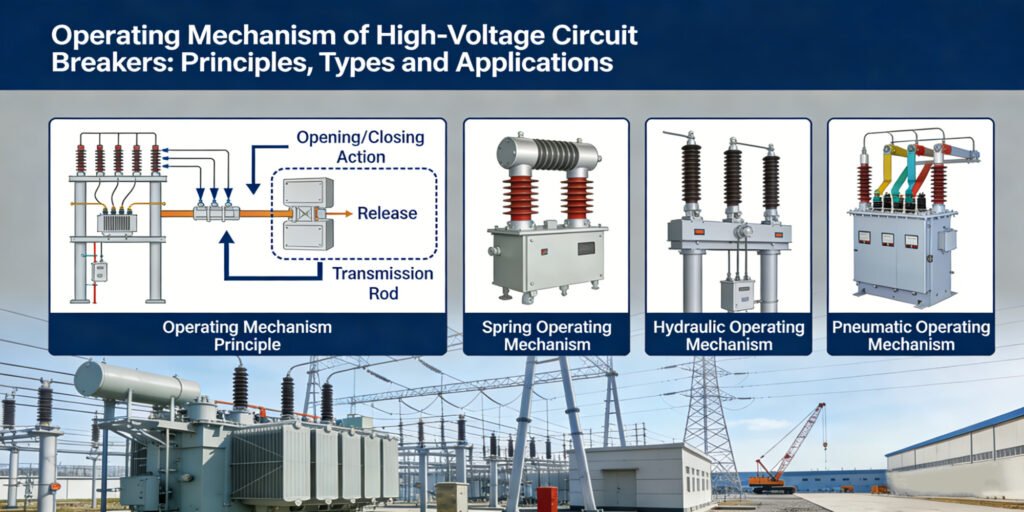
The operating mechanism of a high-voltage circuit breaker is designed to convert mechanical or electrical energy into driving force, controlling the opening and closing of the breaker’s contacts. Its core function is to achieve rapid, accurate contact separation during faults (typically within milliseconds) to cut off short-circuit currents, preventing equipment damage and power outages.
During normal operation, it maintains stable contact closure to ensure uninterrupted power transmission. Key performance indicators include operating speed, reliability, mechanical life, and compatibility with the circuit breaker’s rated voltage and current levels—all aligned with international standards such as IEC and ANSI.
Common Types of Operating Mechanisms
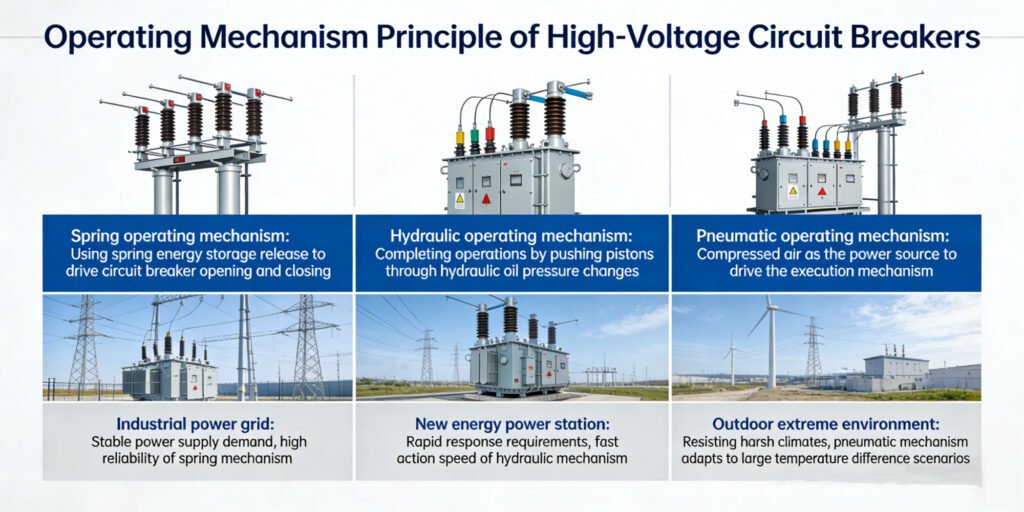
High-voltage circuit breakers adopt three mainstream operating mechanism types, each tailored to specific application scenarios:
1. Spring Operating Mechanism: The most widely used type, storing energy via pre-compressed springs. It features fast action, low maintenance, and suitability for frequent operations, making it ideal for 10-35kV medium-voltage systems in industrial plants and urban power distribution networks.
2. Hydraulic Operating Mechanism: Utilizes hydraulic pressure to drive contact movement, offering high operating force and stable performance. It is commonly employed in 110kV and above high-voltage circuit breakers for large power grids and renewable energy generation facilities (e.g., wind and solar farms).
3. Pneumatic Operating Mechanism: Relies on compressed air for energy transmission, characterized by simple structure and resistance to harsh environments. It is preferred for outdoor high-voltage applications in extreme temperature or high-humidity areas.
Key Advantages and Application Scenarios
A high-quality operating mechanism delivers three core benefits: reliable fault interruption (ensuring rapid current cutoff to protect power equipment), long mechanical life (withstanding thousands of operations without failure), and low operational noise (adapting to indoor and urban settings). These advantages make high-voltage circuit breakers with advanced operating mechanisms essential in:
For power equipment professionals and project managers, selecting a high-voltage circuit breaker with a robust operating mechanism is non-negotiable. It reduces unplanned downtime, lowers maintenance costs, and enhances overall grid resilience.
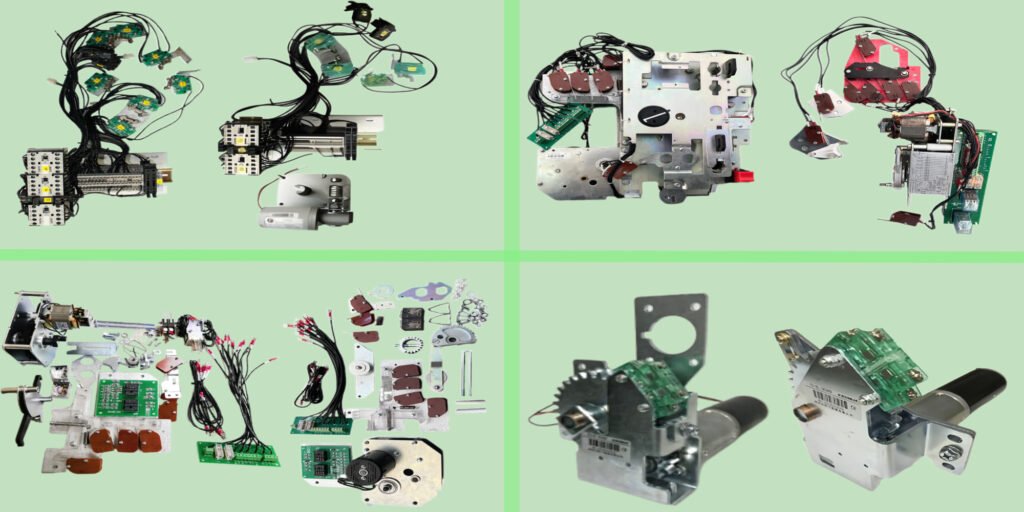
Xizi Energy delivers premium medium/high-voltage electrical equipment, equipped with electric operating mechanisms suitable for Schneider, Siemens, and ABB switchgear. IEC/ANSI-certified, our products suit industrial grids, renewable energy plants, and urban power systems—your trusted partner for safe, efficient power components.
Professional Medium & High Voltage Electrical Equipment Manufacturer