
In the electrical equipment industry, relays and load switches are indispensable components for managing power flow, yet their distinct functionalities often lead to confusion. Both play critical roles in circuit control, but they cater to different power requirements, application scenarios, and operational needs. Understanding their key differences helps professionals select the right component for industrial systems, household appliances, or remote control setups.
Core Definitions & Primary Functions
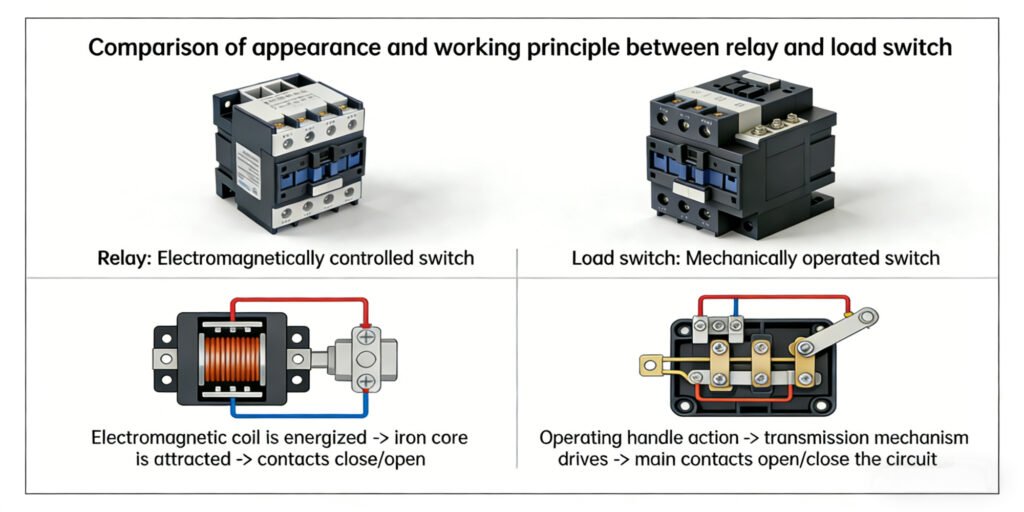
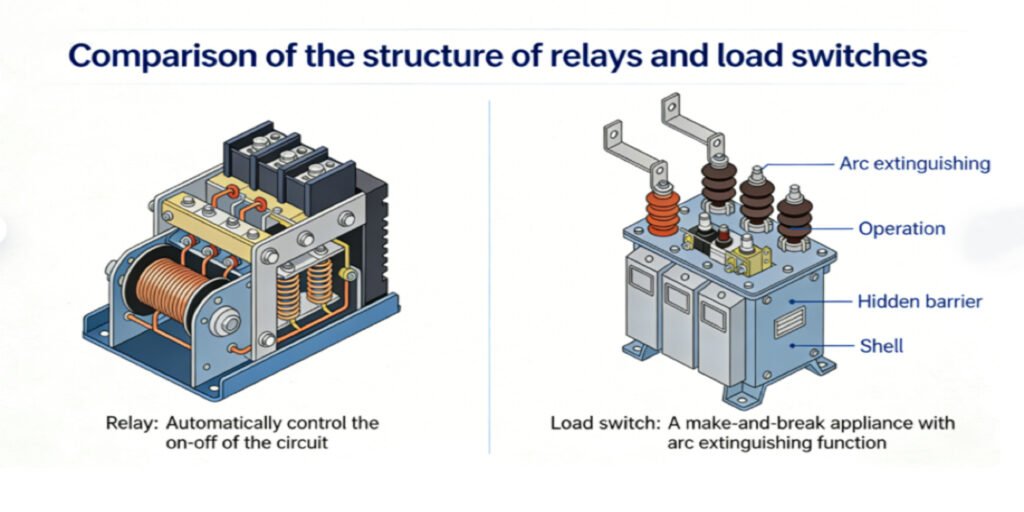
A relay is an electromechanical or solid-state device that uses a low-power signal to control high-power circuits. It acts as an intermediary, switching large currents on/off by activating a small electromagnetic coil.
Relays excel at remote control, automation, and protecting circuits from overloads—they can detect faults and disconnect power automatically, ensuring system safety. Common types include protective relays for electric motors and magnetic latching relays for long-distance operations.
A load switch, by contrast, is a specialized switch designed to directly handle the electrical load of a circuit. Its primary function is to interrupt or connect power flow to a specific load (e.g., motors, heaters, or electronic devices) without the need for an intermediary signal.
Load switches are built for frequent manual or automatic operation, focusing on reliable load control rather than signal amplification.
Key Differences: Relay vs. Load Switch
| Aspect | Relay | Load Switch |
| Power Control | Controls high-power circuits via low-power signals | Directly manages load current (no signal amplification) |
| Application Scope | Industrial automation, remote control, overload protection | Household appliances, local load management, frequent on/off cycles |
| Safety Features | Built-in fault detection and overload protection | Basic insulation; relies on external protection devices |
| Versatility | Handles complex systems (multiple circuits, remote operation) | Specialized for specific load capacities and applications |
| Operational Mechanism | Electromagnetic coil or solid-state activation | Manual toggle, rocker, or automated mechanical switching |
Application Scenarios & Use Cases
Relays are ideal for scenarios requiring remote control or high-power management. They are widely used in industrial settings to control assembly lines from a central panel, in automotive systems to switch headlights or starter motors, and in renewable energy setups to regulate power distribution. Their ability to isolate low-voltage control circuits from high-voltage loads makes them essential for safety-critical applications.
Load switches shine in local load control where direct operation is preferred. Examples include wall switches for lights, toggle switches for power tools, and rocker switches for household appliances like blenders or air conditioners.
They are also used in industrial machinery to activate specific components (e.g., a conveyor belt motor) and are valued for their durability in frequent-use environments.
How to Choose the Right Component?
Select a relay if you need:
- Remote or automated control of high-power devices
- Overload protection and fault detection
- Isolation between control signals and load circuits
Opt for a load switch if:
- Direct, manual control of a specific load is required
- The application involves frequent on/off cycles
- Cost-effectiveness and simplicity are priorities (no need for signal amplification)
Xizi Energy is a leading medium and high-voltage electrical equipment manufacturer, specializing in R&D, production and global supply of high-performance relays and load switches.
With a professional R&D team, advanced manufacturing & testing facilities and full-process quality control, we provide standard products, custom solutions and one-stop services (pre-sales consultation, in-sales customization, after-sales support), serving global customers as a trusted partner for safe and efficient circuit control.
Professional Medium & High Voltage Electrical Equipment Manufacturer